
In our previous article, we explored how behavioural bases safety (BBS) and Visual Felt Leadership (VFL) work together to create safer, more engaged workplaces. A fundamental element underpinning any effective BBS programme is a solid understanding of human behaviour – what drives it, what influences it, and how it can be changed sustainably.
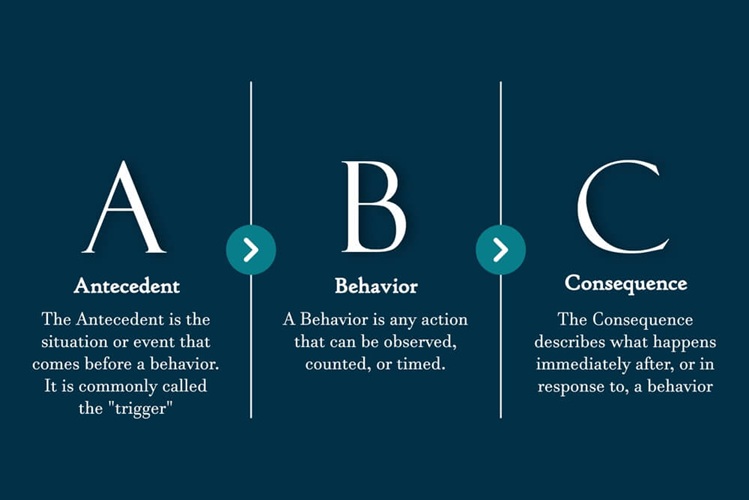
At the core of this understanding lies the ABC Model: Antecedent – Behaviour – Consequence. This deceptively simple framework is a powerful psychological tool that helps organisations decode why people act the way they do – and more importantly, how to shape safer behaviours in the workplace.
What is the ABC Model of Behaviour?
The ABC model is rooted in behavioural psychology and provides a clear structure for understanding what influences human behaviour.
Description
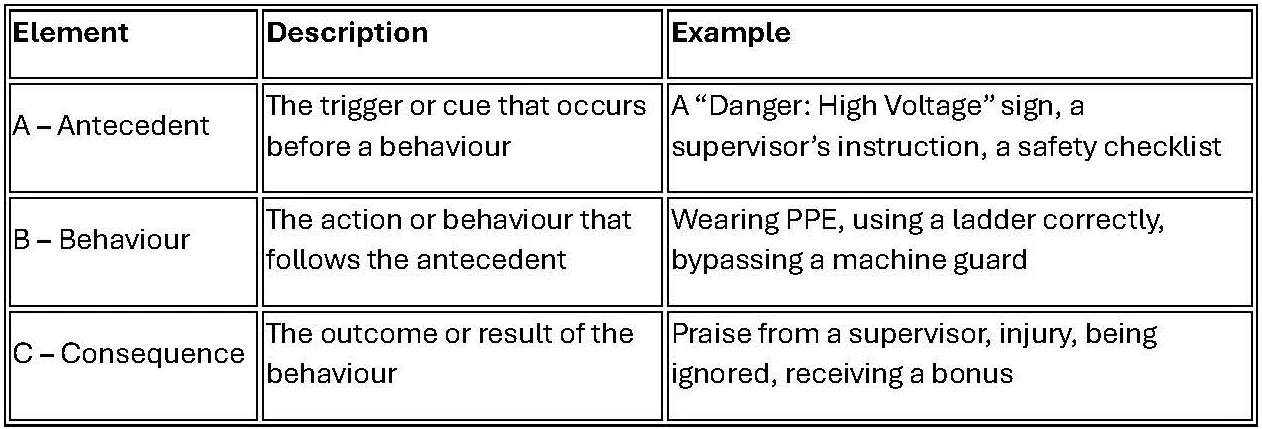
The ABC model emphasises that consequences have the greatest influence on whether a behaviour is repeated or not. While antecedents (like signs or procedures) can prompt a behaviour, it’s the consequence that determines whether the behaviour becomes habitual.
How the ABC Model Integrates with Behavioural Based Safety (BBS)
In BBS, we observe behaviours, identify what triggers them, and understand what consequences are reinforcing them – whether positive or negative.
For example:
- If a worker consistently by passes safety barriers to save time, the antecedent might be a tight production schedule. The consequence might be completing tasks faster without immediate punishment, which reinforces the unsafe behaviour.
- Conversely, if a worker receives recognition or praise for reporting a hazard or following correct procedures, this positive consequence is likely to reinforce safe behaviours.
By applying the ABC model, safety leaders can:
- Identify patterns of unsafe behaviour
- Understand what motivates those behaviours
- Design better antecedents (e.g., clearer signage, better instructions)
- Shape consequences (e.g., coaching, rewards, feedback) to support the desired behaviour
Key Principles of the ABC Model in BBS
- Antecedents: Are Weak on Their Own
Rules, signage, toolbox talks, and safety systems are essential – but they’re not enough. They can prompt behaviour but are limited in sustaining it. Without appropriate consequences, antecedents will eventually lose their impact. - Consequences: Drive Long-Term Behaviour
People tend to repeat behaviours that are positively reinforced and avoid behaviours that have negative consequences. However, a lack of consequence (whether positive or negative) can also lead to complacency. - Positive Reinforcement Is More Powerful Than Punishment
While discipline and enforcement may stop unsafe behaviours temporarily, positive reinforcement creates lasting change. Recognition, praise, peer support, and even small rewards for safe actions can have a significant impact.
- Timeliness Matters
The closer the consequence is to the behaviour, the stronger its effect. Immediate feedback, whether positive or corrective, is much more effective than delayed action. - Behaviour Is a Response to the Environment
BBS encourages us to look beyond individuals and consider the context, conditions, and culture that drive behaviour. Sometimes, the system—not the person is the root cause.
Practical Application of the ABC Model in Safety Culture
To implement ABC thinking in a workplace safety programme, consider the following steps:
1. Observation and Diagnosis
Observe workplace behaviours systematically.
Identify what precedes unsafe or safe behaviours (antecedents).
Note what consequences follow those behaviours – both intended and unintended
2. Redesign Antecedents
Make safety cues clearer and more engaging (e.g., visual prompts, prompts in morning briefings, gamified checklists).
Train supervisors to act as positive antecedents through leadership behaviours.
3. Reinforce with Positive Consequences
Provide real-time feedback for observed safe behaviours.
Celebrate safety success stories publicly.
Introduce peer-to-peer recognition systems.
4. Address Unintended Consequences
Sometimes unsafe behaviour is inadvertently reinforced by the system (e.g., cutting corners is faster, lack of enforcement sends a message that safety isn’t a priority). These need to be identified and corrected.
5. Close the Loop
Communicate observed trends, changes, and actions taken based on behavioural observations.
Empower employees to be part of the solution through feedback and collaboration.
ABC in Action: Real-World Example
Scenario: Workers routinely enter a restricted area without proper permits.
Antecedent: The barrier is left open, and no one monitors the area.
Behaviour: Workers shortcut through it to save time.
Consequence: No one is reprimanded, and the job gets done faster.
BBS Intervention: Supervisors close off the area properly, introduce a pre-task permit check, and positively acknowledge workers who follow the process.
New Antecedent: Clear permit requirement reinforced at pre-start.
New Consequence: Positive feedback from supervisor, safety bonus points system.
Behaviour Change: Workers start adhering to the permit process more consistently.
Conclusion: ABC is the Engine Behind Culture Change
The ABC Model is not just theory — it’s the backbone of any effective Behavioural Based Safety program. It helps organisations shift from blaming individuals to understanding and influencing behaviour at its root cause. When organisations combine ABC analysis with strong Visual Felt Leadership, they create a safety culture that is not just compliant—but truly transformational.
Behavioural change is not about telling people what to do — it’s about helping them want to do it, because the environment, leadership, and culture all support and reward the right choices.
LinkedIn – FB Article
**How the ABC Model Drives Behavioural Safety and Culture Change in the Workplace**
In workplace safety, rules and procedures are critical — but understanding human behaviour is what truly transforms a safety culture.
The ABC Model – **Antecedent, Behaviour, Consequence**—is a simple but powerful framework at the heart of Behavioural Based Safety (BBS).
✅ **Antecedents** are triggers or cues (e.g., signage, briefings).
✅ **Behaviour** is the action taken (e.g., wearing PPE).
✅ **Consequences** are the results that reinforce or discourage behaviour (e.g., praise or injury).
🚨 The real game-changer? **Consequences drive long-term change.** When workers are recognised, supported, and coached—not just punished—safe behaviours become habits.
🔍 Using ABC analysis allows leaders to uncover why unsafe behaviours occur, redesign processes, and reinforce the right actions.
👷♀️ When ABC is paired with **Visual Felt Leadership (VFL)**—where leaders lead by example on the ground—the impact on safety culture and compliance is profound.
Let’s move from a “tick-box” safety culture to one that’s proactive, behavioural, and people-focused.
📩 Want to know how to embed BBS and ABC in your safety culture? Let’s connect, drop us an email at info@proguardconsulting.co.uk